

Everyone settled in their seats in the Morris Hills band room on the dates of March 9 during Block 1 and Block 3 A/B Lunch, on March 10 for Blocks 5 and 8, appreciating the privilege of hosting musician, educator, author, professor and composer Dr. William Stowman.
In terms of informing about the active participants for each session, Block 1 involved the Concert Band, the session during Block 3 A/B lunch involved the Lunch Bands, and block 5 included the Advanced Band, while Block 8 was with the Concert Band.
To start off the session, Dr. William Stowman performed his own composition on the trumpet. He then went around the room to ask the following questions: what everybody’s name was, the instrument that they play, and how they felt about the piece they had just heard.
At first, the terminology used by the students to describe what they had just heard was fairly technical. Several students described his playing as featuring impeccable legato and clarity. Some people stated that the notes they heard were very “clean” or “smooth,” which aligns with what is stated about his playing by Fanfare magazine, as he incorporates “crystalline clarity of tone and impeccable legato” within his work.
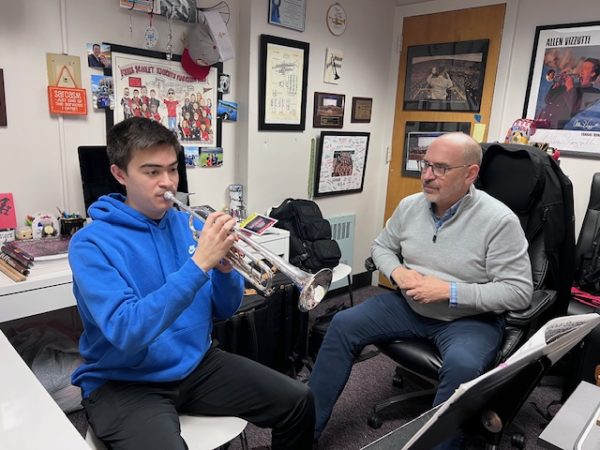
Then, the students used descriptive language relating to visual components, stating that his piece reminded some of water flowing down a waterfall. Araceli Gomez stated that the piece reminded her of a peaceful garden bestowed with a plethora of flowers. Moses Jee called the piece very “peaceful” and “heavenly.”
Michael Flannery called the piece “nostalgic” and “emotional,” and spoke of how it resonated with him because it reminded him of other pieces he had listened to in the past.
After these comments were made, the students were instructed to focus on breathwork, starting with the flutes and then moving on to other instruments in the Concert Band. Dr. William Stowman believes that the “voices” of flutes have a center, a further continuation of that center that transforms into a circle as the length of that note elongates, and a “shimmering” effect at the end. Dr. Stowman’s perspective is thoughtful, intentional, detailed, respectful and original to him.
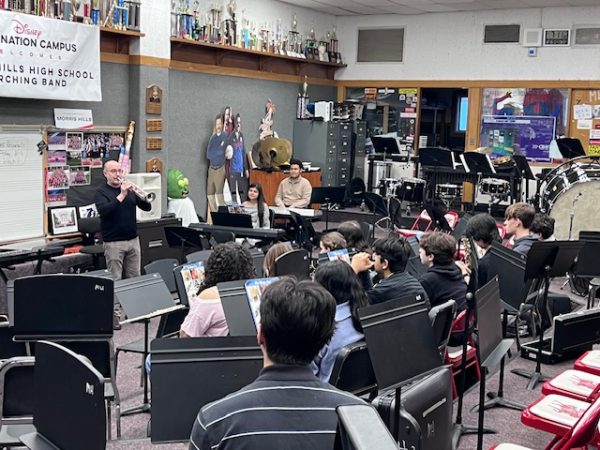
Students were tasked with voting the performances of pieces that they preferred the most, and then discussing why those allocated the most votes were picked. Some individuals out of the group were called up to the front and used as examples for the rest of the members of the session to follow. After fluency in playing notes is learned in-depth, students can then add on different techniques such as using various extents of vibrato.
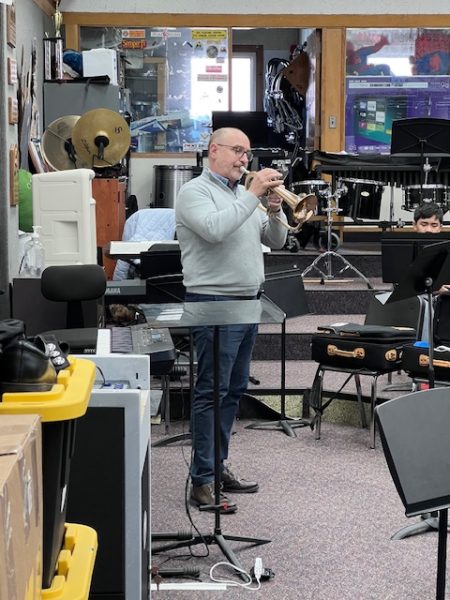
Ombercheure, aperture and articulation were all concepts that were discussed as well. These concepts were related to the theme of connectivity, which one student had made about Dr. Stowman’s trumpet performance of his piece at the beginning of the session.
Speaking of connectivity, the session drew to a close while discussing various volumes of his 26 Contemplative Studies. They consist of pieces that he composed that align itself with written pieces, painting a picture for those who are to listen to the piece afterwards and gain a more heightened perception of it.
This connectivity ties in with the value of confluence, relating to more than the junction in which two rivers join–it is the place in our lives where everything comes together. It discloses the power behind one decision, and the similarities between concepts that can be developed over time.
Everflowing Notes with Dr. William Stowman
Isheeta Chandrasekhar, Staff Writer
March 16, 2026