
On May 21, seniors from the Academy for Mathematics, Science, and Engineering (AMSE) presented their capstone engineering project at the annual Academy Showcase. This year’s theme, “Habitat,” challenged student teams to design products that improve environments for humans, animals, and ecosystems alike. From coral reef restoration to smart nutrition tracking systems, each team combined engineering, research, and creativity to solve real-world problems.
The showcase highlighted not only technical skill, but also perseverance. Many groups faced setbacks ranging from design flaws to missing components, forcing them to rethink and redesign their products throughout the year. Despite these challenges, every team produced a unique solution aimed at making a meaningful impact.
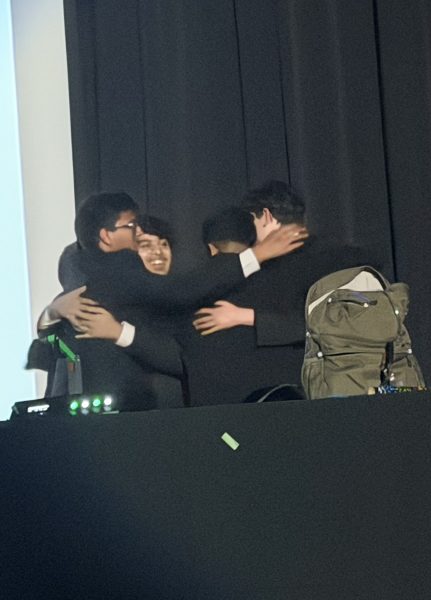
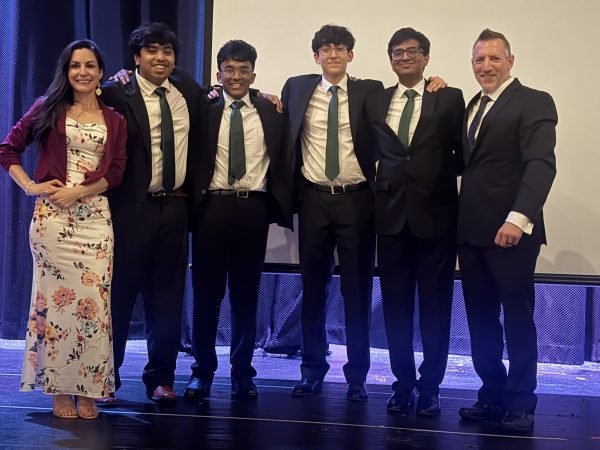
The winning project, Caltrack, created by the Green Team — Abhinav, Anirudh, Sahaj, and Rayan — focused on improving the accuracy of dietary tracking. The team identified flaws in both manual calorie counting and AI photo-based nutrition apps, which are often unreliable and inconsistent. Their solution uses a scale, depth sensor, and barcode scanner to calculate nutritional values with greater precision by measuring food weight directly and determining nutrients per gram. Unlike generic online estimates, Caltrack provides individualized nutritional data for each food item, allowing for more accurate calorie and nutrient tracking. The product also features a sleek, minimalist product design inspired by Apple aesthetics, reflecting the team’s emphasis on both functionality and user experience. Although the group described themselves as less engineering-focused compared to some others in the showcase, they intentionally chose a project that aligned with their combined strengths in biology, biomedical engineering, and economics. The team also faced challenges fitting all of the wiring and components into the compact casing, but they viewed overcoming those obstacles as part of the design process. Their project stood out for its real-world practicality and potential for everyday use.
Other projects addressed a wide range of issues. The Black Team’s EZ Breeze developed an automatic oxygen regulation system that adjusts oxygen flow based on a user’s body vitals, helping people who rely on portable oxygen supplies conserve energy and oxygen. After pivoting from an earlier design concept, the team focused on implementing a solenoid valve system capable of automatically adjusting oxygen delivery in real time. The Orange Team’s TruGrow created a low-cost soil testing system that helps farmers measure ammonia and phosphate levels quickly and accurately, reducing unnecessary fertilizer use and environmental damage. By simplifying the testing process and lowering manufacturing costs, the team designed a product that could make soil testing more accessible for farmers.
Environmental sustainability was a major focus across several projects. The Yellow Team’s Shrimphony aimed to restore coral reefs by mimicking shrimp vibrations to attract oysters back to damaged reef ecosystems and improve biodiversity. The team emphasized environmental conservation and designed the structure to remain stable on the ocean floor through a layered concrete base. The Purple Team’s SmartHive designed a temperature-regulated transport hive to safely transport queen bees over long distances, addressing a problem many people may not realize exists: queen bees face serious temperature-related dangers during transport, including fatal abdominal ruptures. The group focused heavily on the product’s appearance and lightweight structure while ensuring the queen bees remained protected during transportation. Meanwhile, the Red Team’s HeatHarvest explored ways to convert wasted solar heat into usable electricity, increasing the efficiency of solar panels. The team highlighted the scalability of their product and its potential to improve renewable energy systems rather than replace them.
Several teams concentrated on improving everyday convenience and workplace efficiency. The Pink Team’s Eyecandy projected speaker notes directly into a presenter’s glasses to improve communication and presentation skills. The team spent significant time optimizing the internal layout of the device to create one of the smallest and most compact products in the showcase. The Gray Team’s Smart Window introduced a Bluetooth-controlled industrial window system to reduce dangerous manual labor on tall buildings and warehouses. After discovering their motor lacked sufficient torque, the team engineered a custom gearbox system to compensate, demonstrating creative problem-solving under strict project constraints. The Blue Team’s Electropulse focused on improving reverse osmosis water filtration systems by using a rotating electric field to reduce biotic buildup on membrane pores. The team described the project as highly experimental and emphasized the originality of their design, particularly the electrode system surrounding the device.
One of the most impressive aspects of the showcase was the diversity of ideas. Students explored healthcare, agriculture, sustainability, workplace communication, renewable energy, and industrial safety — all under the same theme. Although each project was different, all shared a common goal: using innovation to improve habitats and quality of life.
The Academy Showcase demonstrated how engineering can extend beyond the classroom and into solving practical, real-world challenges. Through months of research, testing, redesigning, and teamwork, AMSE seniors transformed ambitious ideas into functioning prototypes. Their projects reflected not only technical ability, but also creativity, adaptability, and a strong commitment to making a positive impact.